
How Route Optimisation Reduces Carbon Without Reducing Service
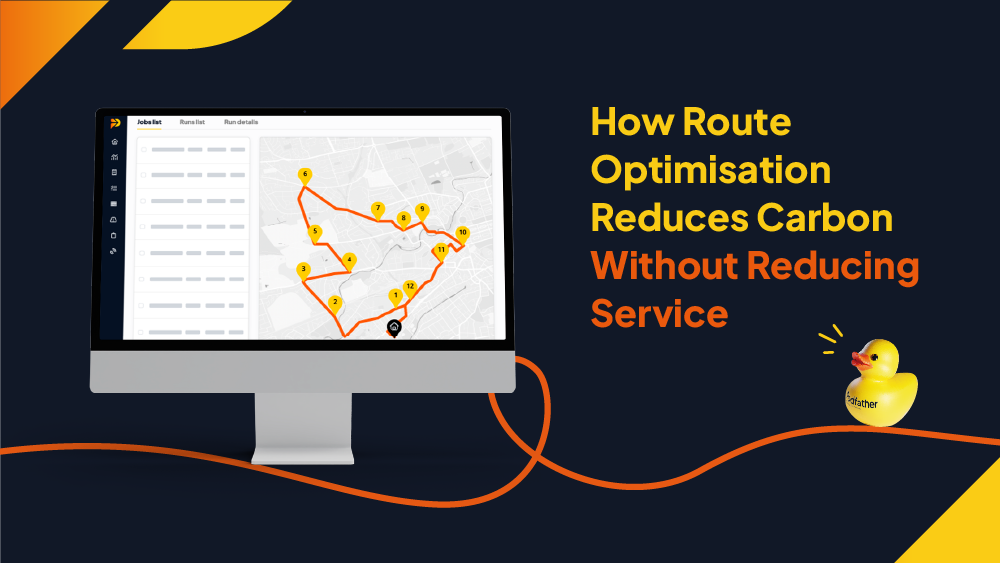
For logistics and fleet-based businesses, sustainability is no longer just a nice-to-have, it’s a critical consideration. Companies are under increasing pressure to reduce their carbon footprint, not only to meet regulatory requirements but also to meet customer expectations. At the same time, maintaining high service levels remains essential. The good news is that route optimisation allows businesses to achieve both: reducing carbon emissions while continuing to deliver excellent service.
What is Route Optimisation?
Route optimisation is the process of planning the most efficient paths for your vehicles when making deliveries or servicing customers. Unlike traditional route planning, which may rely on driver knowledge, spreadsheets, or simple mapping tools, route optimisation uses advanced algorithms to consider multiple factors at once: delivery windows, vehicle capacity, customer priority, and traffic patterns.
The result? Shorter distances, fewer unnecessary journeys, and smarter scheduling, all without compromising service quality.
Reducing Carbon Without Compromising Service
Reducing carbon doesn’t mean making trade-offs in delivery times or customer experience. Here’s how route optimisation makes it possible:
- Minimising Mileage: Every extra mile driven adds fuel consumption and carbon emissions. By calculating the most efficient route for each vehicle, route optimisation ensures that deliveries follow the shortest and most logical path. This means fewer miles on the road, lower fuel consumption, and reduced greenhouse gas emissions, all without changing the number of deliveries or the service level your customers expect.
- Efficient Scheduling: Route optimisation takes into account delivery time windows and operational priorities. This ensures vehicles arrive when customers are ready, reducing waiting times and failed deliveries. Optimised scheduling keeps service levels high while simultaneously reducing fuel use and emissions from unnecessary stops or returns.
- Better Fleet Utilisation: Optimisation tools can distribute workloads across your fleet intelligently. By balancing routes and vehicle assignments, fewer vehicles are required to complete the same number of deliveries. This lowers overall fuel usage and emissions while maintaining reliability and on-time performance.
- Reducing Empty Miles: Many fleets unknowingly drive vehicles with low or no load between deliveries. Route optimisation minimises these “empty miles” by planning routes that allow vehicles to pick up and drop off efficiently. Fewer empty miles mean fewer emissions without any negative impact on service.
- Supporting Sustainable Business Goals: For businesses tracking sustainability metrics, optimised routes provide clear data on fuel savings and carbon reduction. Companies can monitor progress, report on sustainability achievements, and make informed decisions for further improvements, all without compromising delivery quality or customer satisfaction.
The Wider Benefits of Route Optimisation
Beyond carbon reduction, route optimisation also improves operational efficiency. Fewer miles and smarter routes mean lower fuel costs, reduced wear and tear on vehicles, and less pressure on drivers. In turn, happier drivers and more efficient operations enhance service reliability. Additionally, customers increasingly value sustainability. By adopting route optimisation, businesses can demonstrate a commitment to the environment while maintaining fast, reliable deliveries, strengthening customer trust and loyalty.
Making the Change
Implementing route optimisation doesn’t require overhauling your entire operation overnight. Modern solutions, like Podfather’s platform, integrate easily with existing systems, allowing planners to assign routes quickly, make changes efficiently, and measure results accurately. By starting with key routes or high-volume delivery areas, businesses can see immediate improvements in emissions, cost, and service performance.
Conclusion
Reducing carbon emissions doesn’t have to come at the cost of service quality. With route optimisation, logistics teams can drive fewer miles, reduce fuel use, and lower greenhouse gas emissions, all while keeping customers happy with reliable deliveries. Sustainable operations and excellent service aren’t mutually exclusive; they can, and should, go hand in hand. If you want to learn more about how route optimisation can help your fleet become greener without compromising service, contact Podfather today and see how our solutions can make a measurable difference.